"Wood replaces materials with a high climate impact and becomes buildings and products that benefit us humans."
Jan Åhlund, forest specialist at Holmen


Products from the forest are replacing fossil alternatives. Among other things, they will be used for climate-smart schools, offices and apartment buildings and are of great benefit to society, while limiting negative climate change.
Great benefits, for both people and the environment. In addition, there is actually more forest in Sweden today than there was a hundred years ago. Something we can thank responsible harvesting, reforestation and long-term forest management for.
Despite these truths that are as measurable as they are obvious, prejudices abound that Swedish forestry is not sustainable. In fact, Swedish forestry is perhaps the most responsible in the whole world. We asked Jan Åhlund, forest specialist at Holmen Skog, for help in clearing up some myths about the forest.
“There is no deforestation in Sweden. We harvest the trees our forefathers sowed or planted and an average of five to ten per cent of the land area at the site is left untouched for environmental conservation. Trees that are especially important to biodiversity are thus able to live on for ever. Groups of trees are left in buffer zones alongside lakes, watercourses and marshes to preserve shady environments, maintain the water temperature and protect fish stocks. As well as protecting the environment, the way people experience the forest is also respected and special care is taken in areas popular with visitors, where alternative continuous cover forestry methods may be used, for example. This reduces growth but helps to retain the look and feel of the forest over time.”
"The forest is not running out, quite the opposite. For over 100 years, annual and systematic measurements of the forest condition have been carried out, through the so-called National Forest Inventory. It has shown that we have never harvested more than the growth in the forest, which has led to us having more than twice as many trees today, in an unchanged area, as in the early 1900s. I feel confident that Swedish forestry is as sustainable as it can be, with the knowledge we have today about how our ecosystems work. At the same time, we need to continue to learn more in order to be able to constantly develop forestry with the support of contemporary science and experience.
"Wood replaces materials with a high climate impact and becomes buildings and products that benefit us humans."
Jan Åhlund, forest specialist at Holmen
“This statement is scientifically incorrect. When a tree is felled, it is true that photosynthesis stops, but the carbon already stored in the tree stays there. The carbon that has a negative impact on the greenhouse effect in the atmosphere becomes harmless to the climate when it is captured and stored in trees and wood products. This means that forestry can help to reduce dependence on fossil products such as oil, coal and plastic − while simultaneously reducing use of cement and steel, which take huge amounts of fossil energy to manufacture. In other words, active forestry contributes a double climate benefit, firstly from the trees that captured carbon when they were growing and secondly from the finished wood products that keep storing it for a long time.”
“No, because old trees grow slowly and capture less carbon than young, healthy trees. Once their growth slows down, it makes sense from a climate point of view to start again with new, more vigorous trees. If forestry stopped and the trees were left to stand for ever, we would have to replace wood products with fossil alternatives for buildings and energy, which would increase the climate footprint overall.”
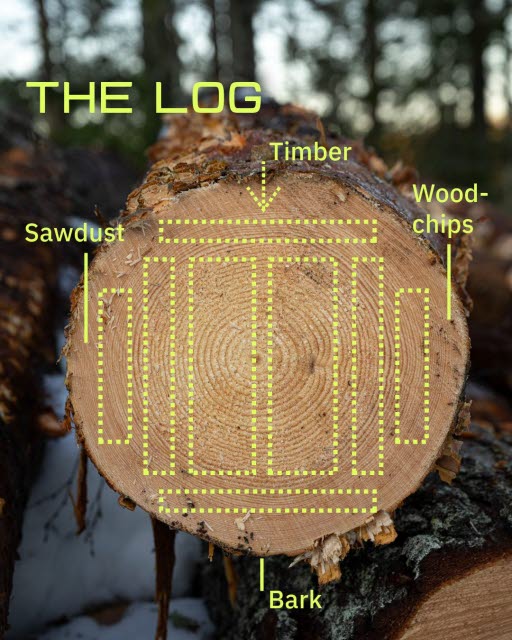
“No, that isn’t true. First of all, the whole tree is used. Nothing goes to waste. When forest is harvested after about 80–90 years, around half of the harvest goes to produce construction material used for housing and furniture. We saw as many planks and boards from the tree as we possibly can. But because tree trunks are round and planks are rectangular, plus the fact that trees also consist of branches, tops, twigs and bark, we also need to make more short-lived products such as paper, paperboard and biofuel. These products also have a high climate benefit as they are able to replace plastic packaging and fossil fuels, for example.”
“Sweden was the first country in the world to introduce a Forestry Act, back in 1903. This legislation makes replanting compulsory after harvest. This is one of the reasons why we have twice as much forest in Sweden today compared with when the Act was first introduced. Today it is easy to monitor replanting using satellite imaging, and reforestation is taken very seriously. Future generations will continue to have forests to enjoy just as we do today.”
“Small seedlings don’t capture much carbon in the first few years, but by ten years after planting the new trees are taking up more carbon from the atmosphere than the carbon released from the soil. After that, their climate benefit increases rapidly, culminating when the tree is about 50 years old. This is why forest that is varied in terms of its age and tree species is a good thing. It produces the most benefit for the climate and biodiversity.”
“We not only comply with international rules, but we are also one of the most responsible countries on sustainable forestry guidance. The combination of formally protected forest, such as national parks and nature reserves, and extensive regulations on environmental conservation during harvesting helps to preserve biodiversity and ensure high growth.
International studies show that the ecosystems in Sweden have had the lowest impact from humans over time and that we, and Finland, are the only countries in the world with ecosystems that are fully functional. This is scientific evidence that it is possible to actively manage forests and retain biodiversity.”
“I understand how misconceptions about forestry arise. People care about the forest. When big trees are cut down, it changes the character of a place that people love. This can lead to a sense of loss, making it hard to take in the bigger picture and adopt a long-term view. But we need to think about the context and see each forestry measure as part of a wider landscape perspective. Managed or not, the forest’s dynamics will always be changed, whether this is by natural fires, storms or by the owner themselves. Forestry definitely contributes to a more sustainable future. Wood replaces materials with a high climate impact and becomes buildings and products that benefit us.
We should be proud of the responsibility that Swedish forest owners have taken for decades, but that doesn’t mean we know everything.
The forest and its environmental systems are complex and we must listen and be open to new knowledge. We are learning all the time and are seeing the effects of the measures carried out. We work on the basis of the science and research available today and are doing the best we can. I am certain that we will learn even more over time.
Forestry always has to balance lots of different considerations − production, climate benefit and nature conservation. We have been given a unique natural resource and our job is to use it wisely and sustainably. Responsible forestry sees us doing our bit to create a more climate-smart and sustainable society.”