

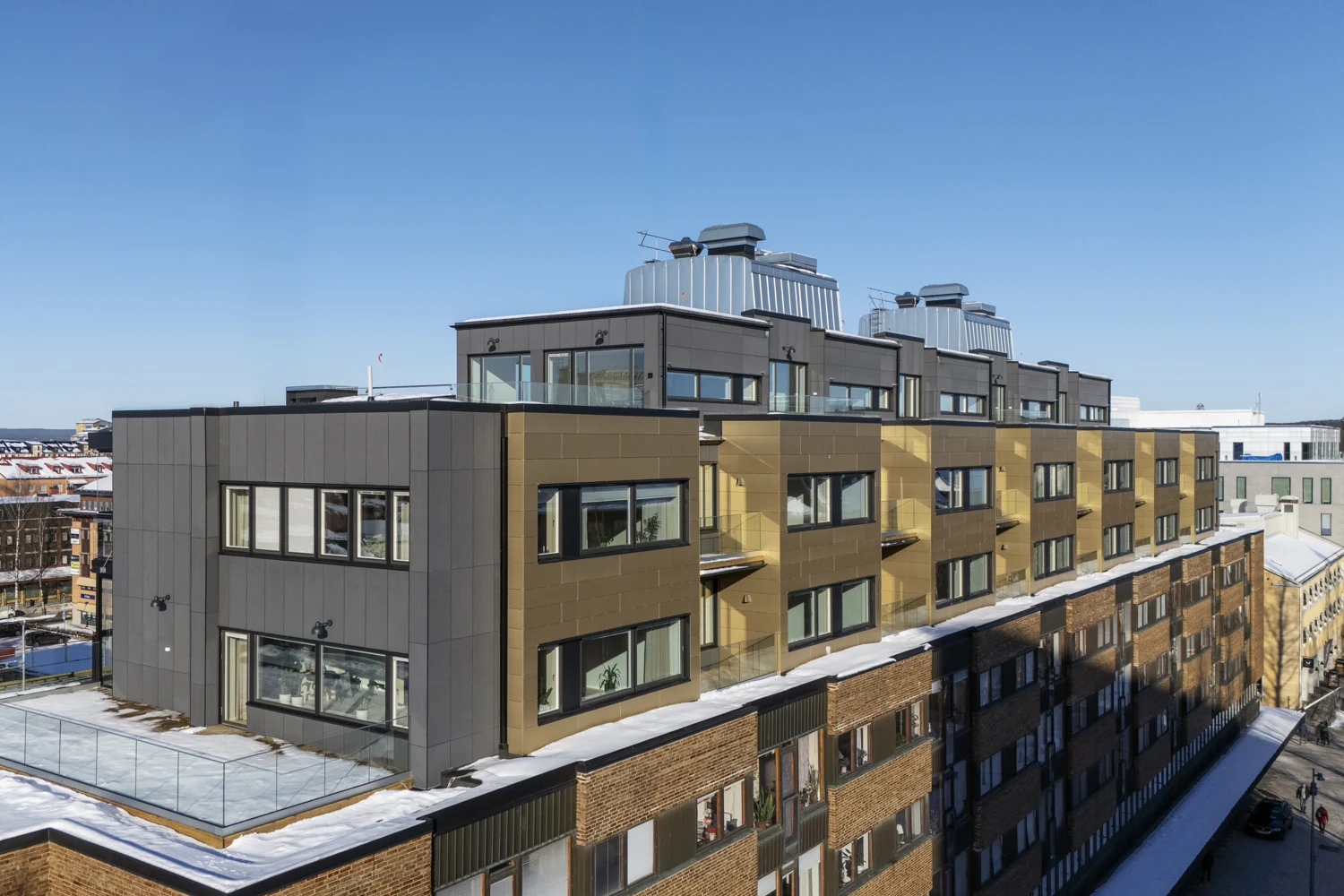
New Heights for Housing in Umea
When demand for more housing in central Umeå increased, attention turned to the buildings already standing. Rather than developing new land, the question was whether the city could grow upwards. At the intersection of sustainable urban development and modern construction methods, the Frigg block gained 23 new rental apartments through a resource-efficient timber vertical extension.
After extensive planning and detailed structural assessments confirmed that the existing building could safely carry the additional loads, the decision was made to proceed. The Valand Building on Rådhusesplanaden in Umeå would be expanded with a three-storey timber extension, rising into the northern sky. It was an ambitious project that reached completion in March 2026, delivering an impressive result both technically and architecturally.
Three New Storeys and 23 Apartments
The idea dates back eight years, when the municipal housing company Umehem acquired the property. At the time, the local zoning plan already permitted a vertical extension. Built in 1965, the building had served as a three-storey property for six decades, with retail and office space on the ground floor and apartments on the two upper floors. The completed project added three new storeys containing 23 modern rental apartments. Although the original design proposed a concrete structure, it was later redesigned in timber.
A key contributor to this lower-carbon solution was Anders Lindgren, Managing Director of AR Bygg, a long-standing partner of Umehem. With more than three decades of experience in extensions, Anders recognised early on the advantages of timber. For him, extension of a building combines technical performance, sustainability and long-term economic value.
"Timber allows you to build upwards quickly and cost-effectively. Its biggest advantage is its low weight," says Anders. "Mass timber products such as cross-laminated timber (CLT) and glulam weigh only about one-fifth as much as concrete. Structural loads determine whether an extension is possible at all, and using a lightweight material like timber is often decisive. Timber is also highly adaptable and can be manufactured in dimensions and grades tailored specifically to each project. It really is the ideal material for vertical extensions."
Building Regulations, Accessibility and Structural Capacity
Before building can begin, it is essential to ensure that all planning and building permit requirements can be met, including accessibility standards, lifts and new stairwells. Some buildings have significantly greater load-bearing capacity than current zoning regulations allow, while others require structural reinforcement.
"The existing building always determines the design of the extension. Accessibility requirements, façades, window layouts, and the location and width of stairwells all define what is possible. Before work began on the Valand Building, we carried out detailed volumetric studies and structural load calculations to establish its exact load-bearing capacity," Anders explains.
Some structural modifications and reinforcements were required before construction could begin. Work commenced in early 2025 after engineers had verified that the additional loads could safely be transferred through the existing structure.
"Once we knew the building could handle the loads and meet the accessibility requirements, we were ready to move forward. Technical challenges such as fire safety, acoustics, plumbing and drainage can always be addressed through engineering solutions, so none of those issues prevented us from proceeding."
Wood as an Architectural Feature
In the spring of 2026, the completed extension was unveiled to the people of Umeå: a technically accomplished project in which timber plays a central architectural role. Glulam and CLT not only form the structural frame but are also intentionally left exposed throughout the building. Even the ceilings showcase visible CLT panels.
"We specified a higher surface finish than is normally used and, instead of covering the structure with plasterboard, we treated the exposed wooden surfaces to comply with fire safety requirements. This approach required more detailed planning and careful execution, but it has performed exceptionally well in practice. The exposed timber has received an overwhelmingly positive response, and the designers, contractors and client are all extremely pleased with the result," says Anders.
Like Assembling a Giant LEGO Set
One of the greatest advantages of vertical extensions is that they can often be completed without requiring existing residents to move out. Temporary weather protection systems keep both the building and its occupants sheltered throughout construction. At the Frigg block, a large construction enclosure protected the building from the elements while allowing residents to remain in their homes. Through clear communication and close dialogue, every tenant in the Valand Building chose to stay throughout the construction of the three new storeys.
The dense urban setting along Radhusesplanaden placed exceptionally high demands on logistics. Every delivery had to arrive in the correct sequence and be installed immediately. The loading order of the prefabricated timber elements followed the installation plan in meticulous detail, as there was virtually no room for on-site storage. With careful planning, timber construction's high level of prefabrication became a major advantage.
"We've been working on a confined and busy site, so the meticulously planned deliveries from Martinsons have been absolutely critical. But when everyone involved performs as well as they have on this project, the job almost feels easy. It's like assembling a giant LEGO set."